香港100M服务器
采用100M BGP混合带宽,可选15M或25M电信CN2带宽,搭配联通、移动直连线路,兼顾内地访问与国际网络连接,适合企业网站、跨境电商及应用部署等业务。


玩家点击“开始游戏”后,界面已经切到战斗场景,服务端却仍把对局标记为“加载中”;或者一个迟到的结算请求把已结束的对局再次推进到结算阶段。遇到这类错误跳转,单独记录“状态变成了什么”通常不够:还要知道是谁在什么请求里发起了哪个动作、服务端当时读到的状态和版本是什么,以及这次迁移是否真正写入。
下面以一局游戏的生命周期为例,实现一条可关联请求、动作、状态和版本的迁移轨迹。示例使用 TypeScript 5 的类型写法和 Node.js 20 内置的 node:crypto、node:perf_hooks 模块;仓储接口需要接入项目现有数据库,不依赖特定 ORM。
假设对局状态依次为:
waiting → matching → loading → running → settling → finished
每一步都由明确动作触发,例如 queue、match_found、client_ready、game_over、settled。状态机负责回答“当前状态是否允许这个动作”,而轨迹负责回答“这次请求实际发生了什么”。
一条有用的轨迹至少应包含:
gameId,用于找到是哪一局游戏。requestId、traceId 和 commandId,用于串起客户端请求、网关转发和游戏服务处理过程。fromState、toState,以及状态版本 versionBefore、versionAfter。action、迁移结果 outcome,以及拒绝或冲突的 reason。状态版本比时间戳更适合判断同一局游戏中的先后关系。两条记录即使因服务节点时钟偏差而出现时间顺序颠倒,也可以通过版本号判断哪次迁移先提交。时间戳适合关联跨服务事件和定位延迟,不应代替版本号充当状态顺序。
先把允许的状态变化写成表。没有列出的状态与动作组合一律拒绝,不要让客户端直接传入目标状态,再由服务端照单写入。
import { randomUUID } from "node:crypto";
import { performance } from "node:perf_hooks";

type GameState =
  | "waiting"
  | "matching"
  | "loading"
  | "running"
  | "settling"
  | "finished";

type Action =
  | "queue"
  | "match_found"
  | "client_ready"
  | "game_over"
  | "settled";

const NEXT_STATE: Partial<Record<GameState, Partial<Record<Action, GameState>>>> = {
  waiting: {
    queue: "matching",
  },
  matching: {
    match_found: "loading",
  },
  loading: {
    client_ready: "running",
  },
  running: {
    game_over: "settling",
  },
  settling: {
    settled: "finished",
  },
};

function expectedActions(state: GameState): Action[] {
  return Object.keys(NEXT_STATE[state] ?? {}) as Action[];
}
这张表的作用不只是检查合法性,也能在拒绝请求时记录当前状态允许哪些动作。比如服务端收到 start_game,但该动作并没有出现在状态机中,就不能把这个请求误记成一次成功迁移。
不同游戏的生命周期可能包含暂停、重连、取消或复活等分支。应按业务规则扩展状态和动作,明确每条边的触发条件;不要为了“让流程走通”而添加含义不清的通用跳转。
轨迹应在服务端处理动作的位置生成,而不是只在客户端切换界面时记录。客户端日志有助于还原玩家看到的现象,但客户端可以延迟、重试,甚至被篡改;对局的权威状态仍应由服务端校验和提交。
下面的代码展示服务层的关键流程。它使用版本号做乐观并发控制,并要求仓储层将成功的状态更新与成功轨迹写入同一个数据库事务。
type GameSnapshot = {
  gameId: string;
  state: GameState;
  version: number;
};

type CommandContext = {
  gameId: string;
  requestId: string;
  traceId: string;
  commandId: string;
  actorId: string;
};

type GameCommand = {
  action: Action;
  clientSeq?: number;
};

type TraceOutcome = "accepted" | "rejected" | "conflict";

type TransitionTrace = {
  eventId: string;
  occurredAt: string;
  elapsedMs: number;
  gameId: string;
  requestId: string;
  traceId: string;
  commandId: string;
  actorId: string;
  action: Action;
  outcome: TraceOutcome;
  fromState: GameState | null;
  toState: GameState | null;
  currentState?: GameState | null;
  versionBefore: number | null;
  versionAfter: number | null;
  reason?: string;
  expectedActions?: Action[];
  inputSummary: {
    clientSeq: number | null;
  };
};

type CommitResult =
  | { committed: true }
  | { committed: false; current: GameSnapshot | null };

interface GameRepository {
  load(gameId: string): Promise<GameSnapshot | null>;

  // 成功时必须在一个事务中更新状态并插入 accepted 轨迹。
  // 版本不匹配时不写 accepted 轨迹,并返回当前状态快照。
  commitTransitionAndTrace(input: {
    gameId: string;
    expectedVersion: number;
    nextState: GameState;
    trace: TransitionTrace;
  }): Promise<CommitResult>;

  // 写入拒绝或并发冲突轨迹,不改变对局状态。
  appendRejectedTrace(trace: TransitionTrace): Promise<void>;
}

function makeTrace(
  context: CommandContext,
  command: GameCommand,
  startedAt: number,
  fields: Omit<
    TransitionTrace,
    | "eventId"
    | "occurredAt"
    | "elapsedMs"
    | "gameId"
    | "requestId"
    | "traceId"
    | "commandId"
    | "actorId"
    | "action"
    | "inputSummary"
  >,
): TransitionTrace {
  return {
    eventId: randomUUID(),
    occurredAt: new Date().toISOString(),
    elapsedMs: Math.round(performance.now() - startedAt),
    gameId: context.gameId,
    requestId: context.requestId,
    traceId: context.traceId,
    commandId: context.commandId,
    actorId: context.actorId,
    action: command.action,
    inputSummary: {
      clientSeq: command.clientSeq ?? null,
    },
    ...fields,
  };
}

async function handleGameCommand(
  repository: GameRepository,
  context: CommandContext,
  command: GameCommand,
): Promise<{ ok: boolean; code: string }> {
  const startedAt = performance.now();
  const current = await repository.load(context.gameId);

  if (!current) {
    await repository.appendRejectedTrace(
      makeTrace(context, command, startedAt, {
        outcome: "rejected",
        fromState: null,
        toState: null,
        currentState: null,
        versionBefore: null,
        versionAfter: null,
        reason: "game_not_found",
      }),
    );
    return { ok: false, code: "GAME_NOT_FOUND" };
  }

  const nextState = NEXT_STATE[current.state]?.[command.action];

  if (!nextState) {
    await repository.appendRejectedTrace(
      makeTrace(context, command, startedAt, {
        outcome: "rejected",
        fromState: current.state,
        toState: null,
        currentState: current.state,
        versionBefore: current.version,
        versionAfter: current.version,
        reason: "invalid_transition",
        expectedActions: expectedActions(current.state),
      }),
    );
    return { ok: false, code: "INVALID_TRANSITION" };
  }

  const nextVersion = current.version + 1;
  const acceptedTrace = makeTrace(context, command, startedAt, {
    outcome: "accepted",
    fromState: current.state,
    toState: nextState,
    currentState: nextState,
    versionBefore: current.version,
    versionAfter: nextVersion,
  });

  const result = await repository.commitTransitionAndTrace({
    gameId: context.gameId,
    expectedVersion: current.version,
    nextState,
    trace: acceptedTrace,
  });

  if (result.committed) {
    return { ok: true, code: "OK" };
  }

  await repository.appendRejectedTrace(
    makeTrace(context, command, startedAt, {
      outcome: "conflict",
      fromState: current.state,
      toState: null,
      currentState: result.current?.state ?? null,
      versionBefore: current.version,
      versionAfter: result.current?.version ?? null,
      reason: "version_conflict",
      expectedActions: result.current
        ? expectedActions(result.current.state)
        : [],
    }),
  );

  return { ok: false, code: "STATE_CONFLICT" };
}
elapsedMs 表示服务层从开始读取到构造该条轨迹时经过的时间,不应被误解为数据库提交耗时。需要分别观察数据库延迟时,应在仓储层记录查询和事务耗时,或添加独立的指标。这样既能保留状态迁移证据,也不会把不同阶段的耗时混成一个数字。
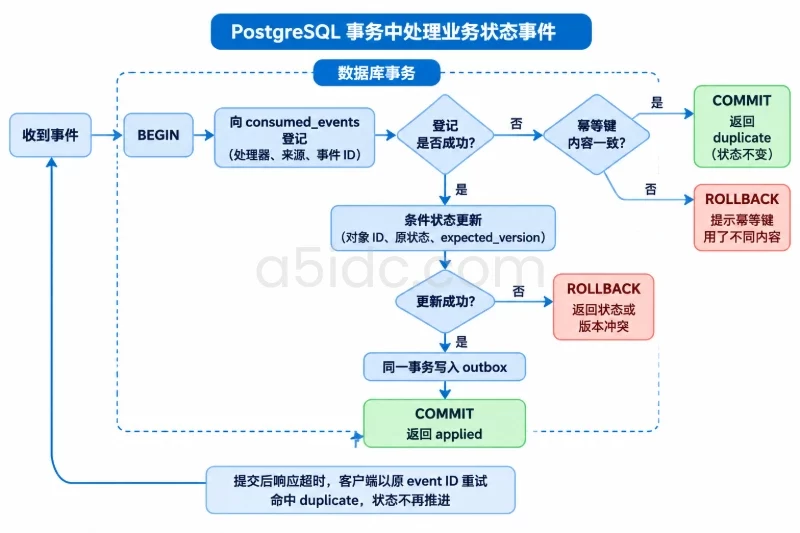
仓储层的关键是保证状态更新与成功轨迹不会一成一败。以 PostgreSQL 为例,事务逻辑可按以下方式实现:
BEGIN;

UPDATE game_state
SET state = $1,
    version = version + 1
WHERE game_id = $2
  AND version = $3;

-- 仅当 UPDATE 影响一行时,才插入本次 accepted 轨迹。
INSERT INTO game_state_transition (
  event_id, game_id, request_id, trace_id, command_id, actor_id,
  action, outcome, from_state, to_state, version_before, version_after,
  occurred_at, reason, input_summary
) VALUES (
  $4, $2, $5, $6, $7, $8,
  $9, 'accepted', $10, $11, $3, $3 + 1,
  $12, NULL, $13
);

COMMIT;
实际实现中要检查 UPDATE 影响的行数:若为零,说明读取状态后已有其他请求先提交,不能插入这条成功轨迹,应回滚事务并返回冲突。拒绝轨迹不改变状态,可以单独插入;如果轨迹属于合规或业务审计的强制记录,写入失败时不能静默吞掉错误。若日志系统只是异步观测设施,则应考虑事务 outbox 等可靠投递方式,避免状态已提交而消息丢失。
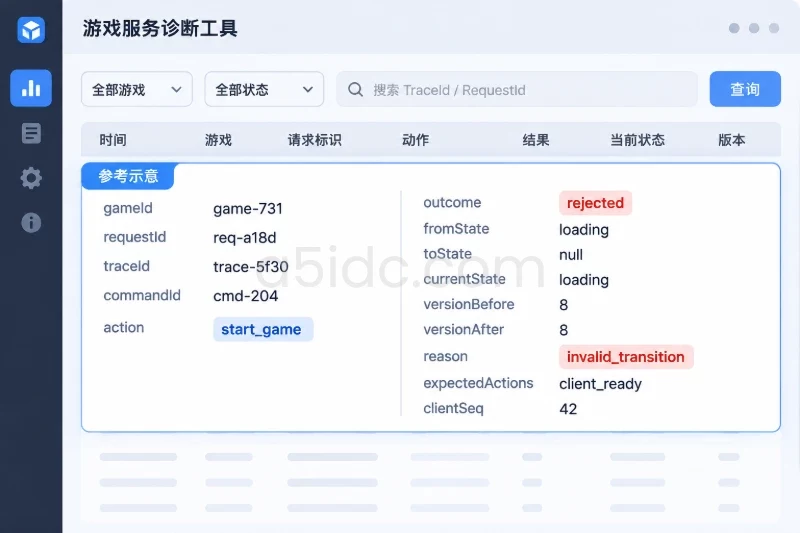
假设对局已经处于 loading,客户端却发送了动作 start_game。服务端拒绝后,日志可呈现为类似下面的结构化记录:
{
  "eventId": "8dbf6b61-5cec-4ed9-a2d4-81bf2bdb9707",
  "occurredAt": "2025-03-08T10:12:31.402Z",
  "gameId": "game-731",
  "requestId": "req-a18d",
  "traceId": "trace-5f30",
  "commandId": "cmd-204",
  "actorId": "player-42",
  "action": "start_game",
  "outcome": "rejected",
  "fromState": "loading",
  "toState": null,
  "currentState": "loading",
  "versionBefore": 8,
  "versionAfter": 8,
  "reason": "invalid_transition",
  "expectedActions": ["client_ready"],
  "inputSummary": {
    "clientSeq": 42
  }
}
定位时可按以下顺序缩小范围:
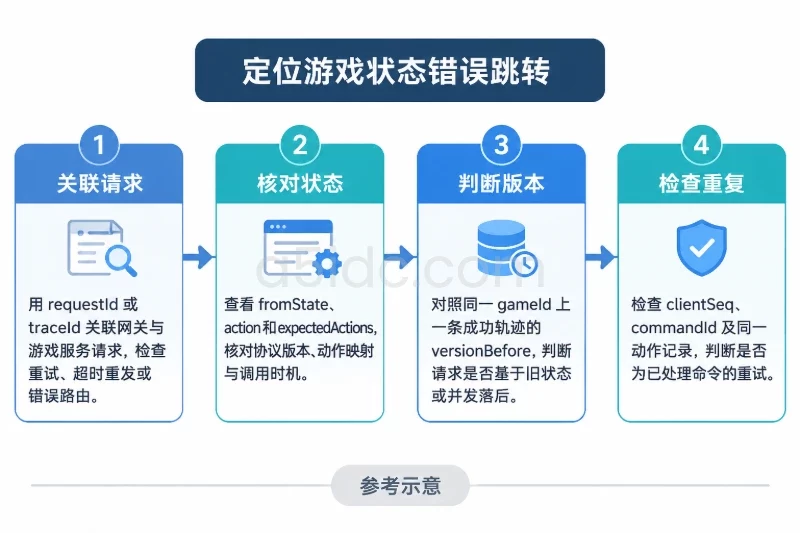
requestId 或 traceId 找到网关和游戏服务的同一请求,确认请求是否重试、超时后被再次发送,或在转发过程中被错误路由。fromState、action 和 expectedActions。如果动作不在允许列表,重点检查客户端与服务端的协议版本、动作映射和调用时机。versionBefore 与同一 gameId 的上一条成功轨迹。如果版本已推进,当前请求可能基于旧状态发出,或者它在并发处理中输给了另一条请求。commandId 和同一动作的重复记录。如果重试命中了已经处理过的命令,不应再执行一次状态变更。例子中的轨迹只能说明服务端在版本 8 观察到 loading,并拒绝了 start_game。它不能单独证明客户端界面为何显示战斗场景;还需要用同一个 traceId 关联客户端发送动作、服务端响应,以及客户端应用响应后的界面事件。客户端时间和服务端时间可能不一致,跨设备比较时间时要留意时钟偏差;同一局内判断先后仍优先看服务端状态版本。
仅靠“先读取状态,再写入新状态”不足以阻止并发错误。两个处理线程都读到 loading 后,可能同时认为自己可以推进状态。版本条件更新让其中一个提交成功,另一个得到 version_conflict;冲突记录还可以带上仓储层读到的最新状态和版本,帮助区分正常竞争与意外跳转。
重试还涉及幂等性。客户端可能因响应超时再次发送同一条命令。服务端应把 commandId 作为幂等键,在状态迁移之外检查是否已经处理过该命令;若已经提交,应返回之前的处理结果,而不是将它作为一条全新的业务动作执行。数据库可对 command_id 建唯一约束,但唯一约束的作用和冲突处理逻辑需要在仓储层一并实现,不能只增加字段就认为重试问题已经解决。
日志内容应围绕定位目标做白名单筛选。通常不需要记录完整请求体、身份凭据、聊天内容或游戏中的敏感用户数据。若需要追查某个输入是否一致,可记录经过筛选的业务字段;对确需比对的内容,也要评估哈希值是否可能被反推,不能把哈希等同于匿名化。
接入后先在测试环境走通一条合法流程,再用非法动作和并发请求验证轨迹。观察时重点检查:
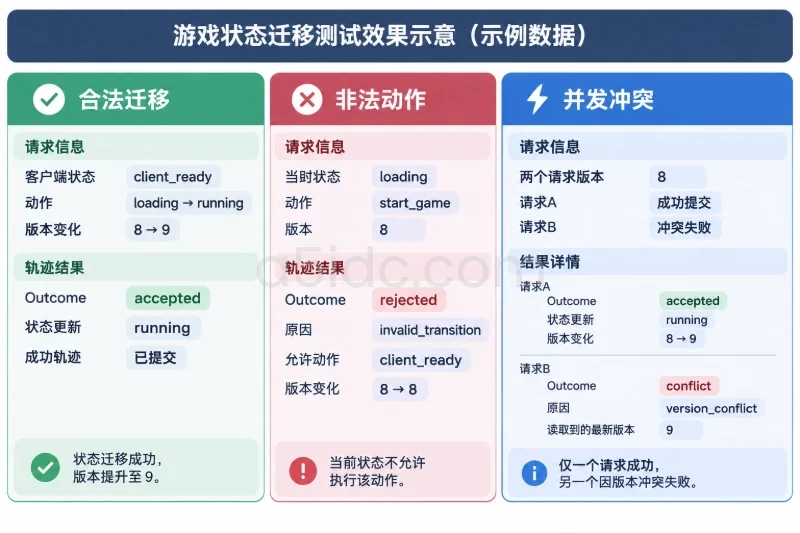
accepted 记录,且 versionAfter 比 versionBefore 大一。rejected,状态版本保持不变,并给出当时允许的动作。conflict 记录。requestId、traceId、gameId 和 commandId,能否分别串起请求链、还原单局状态顺序并识别重复命令。如果项目的状态变化数量少,结构化迁移日志配合当前状态表和版本号,通常就能满足定位需要。若业务要求完整重放每一次领域事件,或需要从事件重建状态,可进一步评估事件溯源;它会改变数据持久化、事件版本和重放策略,并非只是把普通日志保存得更久。无论选择哪种方式,关键都是把“请求了什么”“服务端当时看到了什么”和“状态最终是否提交”分开记录。
对局迁移轨迹最终需要落在服务端的数据处理与保存链路中。A5idc数据提供中国香港、美国、日本等地区的物理服务器租用,涵盖Xeon与AMD平台及SSD、NVMe存储配置,可作为游戏接口服务、状态数据处理和数据库运行所需的硬件资源;不同地区的方案可对应不同用户分布与业务部署需求。
本文由A5数据原创发布,转载请注明出处:https://www.a5idc.com/helpcontent/9973.html